Showing posts with label IndieSnapShot. Show all posts

Tuesday, December 29, 2020

Indie Author Snapshot: The Power of Social Media

One of the questions that many indie authors have is what value social media engagement might hold for marketing their writing. There are a lot of opinions on this subject, and there will always be the case of "so-and-so who became famous because of social media." There will always be some anecdotal tale used as justification for sinking energy into blogs, tweets or other social networking activities. But is this really a strategy that beginning authors should rely upon? Especially authors of fiction? Is there any real evidence that social media makes a difference for most beginning authors - or would they be better off spending their hours on writing rather than posting on Twitter, Facebook or some other site?

At my middle daughter's suggestion, we conducted an investigation to quantify the relationship between social media engagement and book sales for a sample of 124 "new" fiction authors. The authors sampled each had only one novel currently available in their respective fiction genre. Most of the books were Fantasy titles, although a few could have been classified as Science Fiction. A snapshot of each title's Amazon ranking was taken on 26 Nov 2020, and the Amazon ranking was converted into an estimate for each book's daily or annual sales using online tools and resources as described in a previous post.[1][2]


The first comparison which was drawn was an assessment for each book's projected eBook sales versus their price. Previously, for more established indie authors, it had been found that there was a "sweet spot" for balancing sales versus cover price.[3] For these new indie authors, however, that "sweet spot" was not obvious. What was obvious was that authors promoting free books sold considerably more copies than any of the others. To help ensure that the subsequent comparisons were not accidentally skewed, the two titles being promoted as free were omitted from the comparisons which follow.

Comparisons were drawn, exploring possible correlations between sales and social media "likes" on Facebook, Twitter, Instagram, and YouTube, as well as any activity on the author's personal website or blog. Social media "likes" or other activity were tallied for the thirty days preceding the snapshot from 26 Nov.


Out of the 122 new authors, 25 had no Facebook page, and another 46 had a Facebook page but had not posted during the prior thirty days. The remainder had all posted and received "likes" or other interactions during the prior thirty day period. A couple of relationships become evident from this comparison. On the one hand, on average, those authors who were active on Facebook saw 56% more sales than those authors who did not have a Facebook account. Among those authors who were active on Facebook, however, there was virtually no difference in sales between those who posted frequent content and collected many "likes" and those who only posted once or twice in the prior thirty days. The trendline for adding posts and accumulating "likes" was flat.


A similar trend could be observed for Twitter accounts. Of the 122 new authors, 31 had no Twitter account, and another 31 had a Twitter account but had not posted or received "likes" during the prior thirty day period. The remaining authors had at least some degree off activity on Twitter. On average, those authors who were active on Twitter saw 38% more sales than those who were not active. Once again, however, there was no relationship between having more posts and likes on Twitter and accumulating more book sales.


In contrast, there was a trend between accumulating additional "likes" and typical sales activity for those authors active on Instagram. Of the 122 new authors, 42 had no Instagram account, and another 16 had an Instagram account but were inactive during the preceding thirty days. The remaining authors all had some degree of activity on Instagram. From the projected trendline, an author with 10,000 likes during the preceding thirty day period could expect to see nearly three times as many sales as an author who received only 10 likes during this same period. There is therefore evidence for a trend - although the amount of effort needed to go from 10 to 10,000 likes was no doubt significant.


There was also a trend which could be observed from authors with active YouTube accounts, although the sample size for active accounts was smaller. Of the 122 new authors, 94 had no author's YouTube account, 21 had an account but had not been active during the previous thirty days, and only 7 were active during the thirty day period. Of those who were active, there was a correlation between greater social media engagement and increased book sales - but only for those authors at the extreme end of active engagement. More interesting was that on a median basis, those authors who had a YouTube account but were inactive saw 88% more sales than those authors without a YouTube account. Those with minimal YouTube engagement (less than 100 likes in the past thirty days) saw fewer sales on average than those with inactive YouTube accounts, and only those with very active YouTube accounts (more than 1000 likes over the past thirty days) saw an additional increase in their sales beyond this baseline effect. 


Finally, a comparison was drawn to assess any correlation between authors with personal landing sites or blogs and those without. Of the 122 new authors sampled, 23 had no author's site or blog, 84 had an author's site but had not posted or blogged within the past thirty days. Of the remaining authors, those with an active blog or author page, there was no favorable correlation between those who posted more frequently and those who posted less. If anything, there was a negative correlation, where the authors who posted the most saw fewer sales than those who posted less frequently. This was probably a product of the small sample size available. Significantly, however, those authors with a website or blog saw 50% more sales, on average, than those without one.

Taken as a whole, the following trends should be evident:

  • Maintaining a minimal social media presence in the form of a website, and accounts on Facebook, Twitter, Instagram and YouTube has a positive correlation with book sales. If I had to speculate, I would suggest that authors benefit from having a broader footprint which makes it easier for prospective buyers to find them and their books.
  • Adding more frequent posts to either Facebook or Twitter carried no appreciable correlation with additional sales.
  • Adding more frequent posts on YouTube did appear to carry a correlation with additional sales, but only if significant engagement was achieved.
  • Unlike Facebook or Twitter, adding additional posts on Instagram did show a correlation with higher sales - although the amount of effort and engagement needed to achieve 1,000 or more likes over a thirty day period should be weighed against other activities which might also benefit the author and their book sales.

In short, most new authors of fiction would benefit from having a social media footprint which will make their writing easier to find. Additional activity, beyond a post or update once per month, however, appears to carry minimal advantage.

The best advice for new fiction authors was probably summed up in a prior post under this blog: write more books. On average, adding a second book to an author's portfolio will increase total sales by a factor of three. Adding a third book will increase total sales by a factor of more than five.[1] Social media should not be completely neglected, but it is nowhere near becoming the most powerful tool at a writer's disposal. Writing is.


References:

[1] Golan, J.W. "Indie Author Snapshot: The Impact of Adding More Books to an Author's Portfolio." J.W. Golan: An Author's Blog, 8 June 2020. https://jwgolan.blogspot.com/2020/06/indie-author-snapshot-impact-of-adding.html.

[2] Chesson, Dave. "Amazon Sales Rank Calculator." KindlePreneur, 9 Mar 2020. https://kindlepreneur.com/amazon-kdp-sales-rank-calculator/.

[3] Golan, J.W. "Indie Author SnapShot: A Sweet Spot for eBook Pricing." J.W. Golan: An Author's Blog, 8 July 2020. https://jwgolan.blogspot.com/2020/07/indie-author-snapshot-sweet-spot-for.html.

Thursday, July 9, 2020

Indie Author SnapShot: Concluding Remarks

As described when I began this series of posts, a single, one-day snapshot was extracted for Amazon rankings and other key parameters for a cross-section of 24 indie authors in the fantasy genre, spanning 259 books. This data was used to interrogate trends for various metrics - exploring which parameters might influence the sales potential for individual titles.

To recap some of the key conclusions from this exercise:
  • Having more books in an author's portfolio was proven to be the most influential factor in the overall success of each new title.
  • Releasing books in series similarly increased the through-read and sales potential for each book - above and beyond the effect of having additional books in an author's backlog.
  • Covers which feature a human image on the cover lead to better sales - even if the person's face is not visible, or that person's back is facing towards the viewer.
  • Romance is its own cross-genre classification, with its own opportunities for sales. If a novel can appeal to its conventions, a Romance-themed plot-line can promise a huge sales boost - but only if that novel fully meets the expectations for this genre.
  • Within the fantasy genre, female lead characters are more popular than male lead characters.
  • Shelf life means something different for the online, digital age than it did for traditional, brick-and-mortar sales strategies.
  • A book needs to be priced to fit its market. Charging more doesn't necessarily lead to more revenue if it deters sales.
There were a number of things which I couldn't directly explore with this data set. No clear conclusions, for example, could be drawn regarding how reviews on Amazon might influence sales. The data set available was just too small or lacked the right information to draw such a conclusion.

Likewise, this data set could not draw any conclusions regarding the impact of advertising campaigns or the relative merit of different promotional tools. There is still much which can be learned from the experience and growth of individual authors who have made a career from their writing.

I will be indexing the results from this one-day snapshot for future ease of reference - sort of my own way of paying-forward all I have gained from my many fellow authors in the community. I hope this snapshot may benefit other indie authors, as the examples of past successful writers have likewise inspired me.

Wednesday, July 8, 2020

Indie Author SnapShot: A Sweet Spot for eBook Pricing

Among the trends that most indie author/publishers will want to know, is whether there is a sweet spot in terms of the price they should be charging for their eBook.

Anyone who has released a book on Amazon through KDP (Kindle Direct Publishing) has no doubt seen the price and revenue comparisons that are typically provided - which will usually suggest a preferred target price of $2.99 for most eBooks. Anything lower than $2.99 and the author's share of the revenue drops by a factor of two (per Amazon's policies). Anything higher, and the suggestion will be that higher pricing will produce fewer sales - which will in turn translate into a smaller gross income.

I was curious to see if actual indie author data supported this narrative.

Interrogating the available data, there does appear to be a clear trend towards fewer sales as the price of the eBook increases. This drop-off in sales would appear, on average, to more than counteract the added revenue from higher per-unit pricing. Selling ten books at $5.99 will produce less revenue than selling hundreds at $3.99.

Significantly, however, there does appear to be a "sweet spot" for maximizing eBook revenue - at least among the most successful indie authors in this genre. That "sweet spot" appears to be centered around $3.99.

It is possible that the vast majority of established indie authors were also driven to select this "sweet spot" by other market pressures. It may be difficult to justify the cost of advertising, for example, at anything lower than a $3.99 unit price - not when many online advertising services charge on a cost-per-click basis. The picture may also look different for an author/publisher who has not yet achieved these higher volumes.

There will be other levers, of course, available for maximizing sales volume. As an example, from the sample of authors and books assessed, titles which were available as both eBooks and in paperback saw 53-percent more eBook sales than those titles which were available only in eBook form. Having both a paperback and an eBook appears to add credibility and promote sales, even if eBook sales continue to predominate for most indie authors.

Author/publishers who are still working to establish themselves will need to experiment with what pricing works best for their particular title, at their particular stage in their career. But looking to the future, there are indie authors who have already paved the way, and whose example can provide guidance for what many of us aspire to.

Tuesday, July 7, 2020

Indie Author SnapShot: Shelf Life in a Digital Age

In traditional publishing, there is a line of thought which suggests that all books have a very limited shelf life. It is well known that most publishers will campaign heavily, push their new releases onto as many bookstore shelves as possible - and then withdraw the less successful titles after a relatively short window of exposure. Some titles will do very well, and others will fade into obscurity.

Much of this pattern is dictated by the limited space available on the shelves of retailers, as well as the cost of maintaining warehouses full of unsold books. Being a traditional publisher isn't just about selling books, it's also about managing inventory.

Today's indie publishing market, however, is different. It is a market made possible largely due to online sales - bypassing the physical storefronts over which the traditional publishers had a near monopoly. Even the paperback market has been reinvented, with the arrival of affordable, print-on-demand capabilities. Just how different this new indie market is becomes apparent once rankings and sales data are interrogated.

Exploring the data extracted from the one-day snapshot of the indie fantasy scene described under earlier posts, a couple of trends become apparent. One, is that while the very top-selling indie titles do appear to have a limited window for peak sales - that window is measured in months not weeks. The top-selling titles will peak in earnings shortly after release, and gradually lose that added earning potential - but will do so over the course of the next two years. Without the limitations of physical shelf space, the marketability of "new" titles becomes much longer.

Moreover, the sales potential for most indie books appears to be fairly consistent in the span between two to five years after release. Unlike a traditional publisher, which will seek to optimize earnings from a sales portfolio spanning many authors, an indie author/publisher will continue to promote their backlog of books for years to come - encouraging read-through across their entire portfolio. The result is a longer "shelf life" for books which in the brick-and-mortar world of book sales might easily have been forgotten.

Taken in total, it should be evident that the indie author scene represents a different business model from traditional publishing. It is a model based on maximizing the long-term earnings of an author's entire suite of books, not merely the short term opportunities afforded by the shelf space of a physical retailer.

Monday, July 6, 2020

Indie Author SnapShot: The Appeal of Romance and the Choice of Main Characters

I was also curious, from my one-day snapshot of book titles, to see what the correlation was between romance in the novel, and the book's sales potential.

I divided the books based upon the contents of their blurb, between those with a clear, romantic love focus, those which left the potential for a romantic storyline, and those with no suggestion of a romantic sub-plot at all.

Not surprisingly, those books with a clear romantic sub-plot described in the blurb out-sold those with no suggestion of a potential romantic storyline by a ratio of 2.9:1.

Those books which left open only the potential for a romantic interest, however, were indistinguishable from those with no hint of a potential romantic storyline - differing by a little more than 1-percent in sales.

Clearly, romance has a broader appeal - beyond the fantasy genre. But to capitalize on that market, the novel has to be clearly aimed at that market, leaving no ambiguity.

There was also a disconnect in the ratio between female and male protagonists - and how well each book sold. Based upon the description in the blurb, 69-percent of the titles surveyed focused on a single female protagonist, rather than a male protagonist or multiple main characters. Those which did focus on a female protagonist, tended to out-sell those which focused on a male or multiple protagonists by a ratio of 2.1:1.

Both of these trends no doubt reflect heavily on the audience which is most likely to purchase novels in this genre.

Sunday, July 5, 2020

Indie Author SnapShot: The Power of Cover Images

Among the effects which I was most interested to explore, was the relationship between the cover image of a novel, and sales for that novel.

Grading the individual merit of respective cover designs is a highly subjective process. I therefore had to resign myself to a less complicated approach: dividing book covers between those where the main character is front-facing, those where the main character is back-facing, and those which do not have any human figure on the cover.

Including both the original book titles and the compilations for each series, there were 231 books with front-facing figures, 33 with back-viewed figures, and 26 with no human figures on the cover. Taken in total, the books with a front-facing figure on the cover sold about 5.0 times better, on average, than those with no human figure at all. This was essentially the trend which was expected.

Significantly, however, there was minimal difference between books with a front-facing figure and those with a figure viewed from the back (about 1-percent separated the two populations). The real difference came from having an identifiable person on the cover of the book - whether their face was visible or not.

Friday, July 3, 2020

Indie Author SnapShot: Book Length and Readability

There were a few extraneous pieces of data which I also explored in my one-day snapshot for indie author sales in the fantasy genre, which might bear repeating.

For full length novels (books with 200 pages or more), the length of the book had no apparent bearing on its sales success. Shorter novels or novellas (books with less than 200 pages), on the other hand, did tend to generate fewer sales.

This trend should not be surprising. Novellas are often used as promotional tools by authors and are usually priced accordingly. The market has only so much appetite for shorter works of this kind. With regard to full length novels, traditional publishers have often shied away from publishing longer works because of the added printing costs. For indie authors, most of whom will rely heavily on eBook sales, the printing costs for the paperback are a secondary concern. If the story needs to run a little longer, as fantasy books with their world building often do, there is no reason to shortchange the reader.

An assessment for the effect of readability, or "reading grade level", on sales was performed for a limited number of titles. The readability metric was calculated from a short sample of text, extracted from the first chapter of each title, for the first book in each series. A total of 55 books were evaluated in this fashion. The readability metric was averaged by an online algorithm, using a number of standard readability metrics. Most of these metrics measure sentence length (number of words per sentence), and word length (number of syllables or letters per word) to arrive at a "grade level" score.[1]

On average, book sales tended to peak around a readability grade level rating of 5.5, with a trend towards slightly fewer book sales either above or below this value. To place this trend into context, a similar reading sample from JRR Tolkien's The Fellowship of the Ring had a readability grade of 9.9, and a sample from Sarah J Maas' Throne of Glass came up with a readability grade of 7.0.

Books with higher reading levels (longer, more complex sentence structures) can obviously do well enough. But authors should consider their audience and invest the necessary time into editing their novels if they want their audience to embrace their work.


References

[1] "Check Readability." StoryToolz, Kydala Publishing, 2016, https://storytoolz.com/readability

Thursday, July 2, 2020

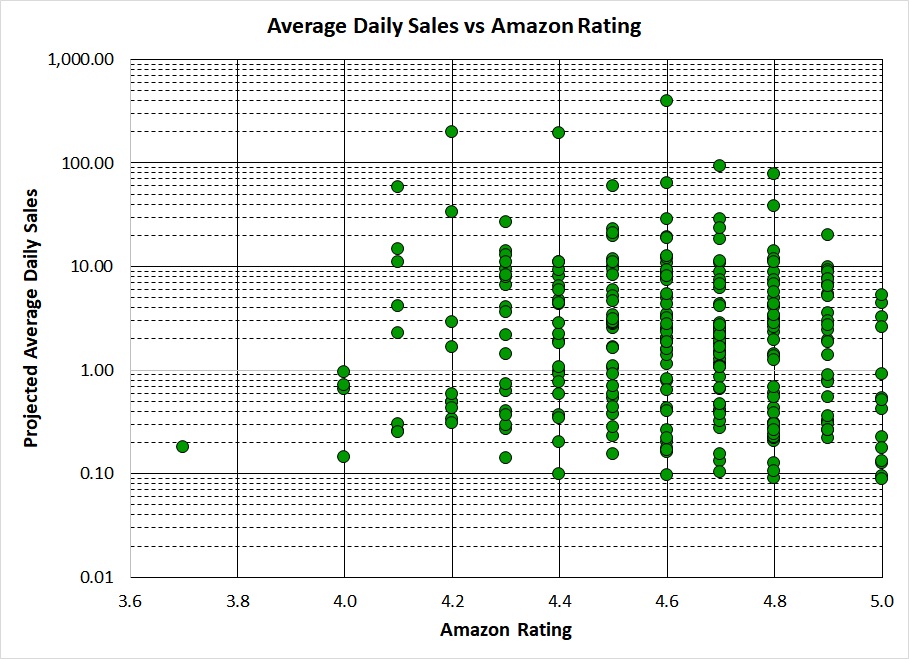
Indie Author Snapshot: Why Ratings and Reviews Do or Don't Matter

Every indie author has probably been told that reviews drive book sales. That adding reviews to an Amazon title will prompt prospective buyers to purchase that title, and how Amazon's secret algorithm for where books place among their recommended products takes reviews into account.

I was therefore eager to see if I could find evidence for this trend in the individual book and author sales data which I collected from my one-day snapshot. Information was collected on the number of ratings, number of reviews, and ratings score for each title from both Amazon and Goodreads.

In general, there does appear to be an overall trend between the number of book ratings and book sales - but it's impossible to determine how much the ratings are driving sales and how much they are a product of those sales. The trend between book reviews and book sales was very similar, and there was little meaningful difference in this trend between Amazon and Goodreads - although there were usually more ratings and reviews for each book on Goodreads than on Amazon.

The relationship between the number of ratings and book sales becomes more revealing, however, when plotted as a frequency - taking into account the average number of days between the release of each review. There is a sharp shift in the slope of this trend for books which receive ratings more frequently than once every 15 days.

These trends, however, appear to be driven more by the popularity of the book than they are by the ability of additional reviews and ratings to generate more sales. There is no sharp shift in the sales potential when the book reaches ten reviews, or twenty, or any other arbitrary break-point.

This does not mean that reviews are unimportant. There are many promotional services, for example, which will not accept a book for consideration until it has exceeded some minimum number of reviews - often around ten. And there may very well be an element in Amazon's search algorithm which takes the quantity of reviews into account. But these effects are less pronounced than other influences might be on a book's success - such as the number of books which the author has in their portfolio, or the advertising strategy of the individual author. There is general agreement that reviews are an important component to an author's success. But they are not the only element, and they do not guarantee a novel's performance.

Similarly, there is no clear correlation between the rating of a book, on either Amazon or Goodreads, and the ability of that title to generate sales. Among the books examined, all of which had a rating of greater than 3.6, each book's rating appeared to have minimal effect on whether readers would be willing to purchase that title. In fact, the highest-grossing titles tended to have a slightly lower rating, a reflection of the broader audience which had reviewed and rated each book. As expected, the Goodreads rating was usually (although not always) lower than the Amazon rating. But the rating score still does not directly correlate with sales.

To understand why some books are more successful than others, we will have to look at other contributors.

Tuesday, June 30, 2020

Indie Author Snapshot: Number of Books in a Series

One of the questions I wanted to answer, when I pulled together my snapshot of indie fantasy authors, was whether there was a "sweet spot" in the number of books which should be included in the same series.

As most indie authors are aware, writing a series of books can be far more effective than writing standalone novels. A series makes it easy for fans of the first book to find the next book by the same author. Series drive read-through, which also makes advertising costs more effective: a single ad can promote an entire series of books, not just one.

Conversely, there's always the question of whether writing a lengthy series of books set in the same world or with the same characters will result in reader fatigue. Even if the next book is set in the same world - would it be better to include it as part of the original series, or might it not be better to begin a new, spin-off series? What is the optimum number of books to include in a single series? Three? Four? Eight?

To draw this comparison, it was necessary to normalize the earnings per book in each series, with the earnings for single, stand-alone novels by the same author. This needed to be done on a per-author basis, to filter out any differences in marketing strategy or sub-genre between the individual authors. Not all of the authors originally surveyed had stand-alone novels to normalize against. This therefore reduced the data set to a pool of 28 series from which to draw comparisons.

The results of this particular survey surprised me. It appears as if there is no practical limit as to how many books can be added to the same series - and yet continue to increase the net worth of each book in that series by a nearly constant factor. In other words, a series of 6 books will earn more on average than two series of 3 books each. This is true, even taking into account the previously mentioned trend between the number of books published and the earnings per book. Aligning the titles into a single series further drives up their marketability.

This was not an outcome I could have predicted, but one which definitely has implications for my own writing. I had planned out my own original series and story-arc to span four books in length, with opportunities for a couple of different spin-off series set in the same fantasy world. These results, however, suggest I would be better off including all of the spin-off novels under the same series label.

Sunday, June 28, 2020

Indie Author Snapshot: The Impact of Adding More Books to an Author's Portfolio

For any indie author who hasn't done so already, there is an invaluable online resource on Facebook known as 20BooksTo50K (R). This indexed Facebook community includes advice and observations from a variety of indie authors, some of whom have become highly successful as self-published writers.

In one survey, members of this community were asked to comment on "that thing" which had made the biggest difference in their success as an indie author. Compiling these responses into categories, there were 101 individual responses to this question. Some respondents provided a list of several key elements which had contributed to their "turning point" as an author, while others cited only that "one thing" which most helped in their career as an author. Of these responses, the majority - over 54% - cited adding more book titles to their portfolio as the single most important element towards their success. The next most popular responses were learning how to do advertising and promotion (30%), and writing to genre (20%).[1]

This was therefore one of the first questions which I sought to explore when reviewing the results from my own, recent data snapshot across a sample of indie authors in the fantasy genre.

As mentioned in a previous post, I surveyed Amazon rankings for 259 titles, and 24 authors - as captured on a single day in June. To convert this snapshot into projected author earnings, I therefore had to convert the Amazon rankings into estimated daily sales, and from sales into revenue.

Fortunately, there is a handy online tool available from KindlePreneur which projects the estimated daily sales, based on the Amazon ranking for each eBook title.[2] Using an equation calibrated against this tool, it was possible to make an estimate for the annual gross income for each author, based on the snapshot in rankings from their respective portfolio of published titles.

A few notes are due for both the merits, and limitations of these projections. First, these are projections only. The estimates are based exclusively on projected eBook sales, and do not include contributions from paperback or audiobook sales - which are usually much smaller than eBook sales for most, but not all indie authors. The totals only reflect sales on Amazon - which is appropriate for the vast majority of the books surveyed. Most of the titles reviewed were Amazon exclusive (KDP Select) novels.

Earnings per sale were projected from Amazon's published rates (35% of the sale price for books less than $2.99, and 70% for books priced at $2.99 or over). These projections ignore the difference between the value of eBook sales, which are based on the price of the book, and KDP Unlimited sales, which are based on the number of pages read. It also ignores any Amazon sales in foreign markets.

Taken as a whole, however, the projections should provide a good sense for trends in author income.

The results from these projections are illustrated in the graph shown, on a logarithmic scale. As should be evident, having more books in an author's portfolio leads to higher author earnings. This relationship is very nonlinear, and nearly quadratic in nature.

A number of alternative regression fits were explored for modeling this trend. The relationship ultimately selected reflects a regression carried out in logarithmic space, with the lowest overall error.

The values projected from this data-match are slightly higher than similar results reported from a poll conducted by Written Word Media, which surveyed over one thousand authors, publishing in a variety of fiction and non-fiction genres.[3]

The results of that survey suggested that the median number of books per author, among those who grossed between $60,000 and $100,000 per year, came out to some 22 titles per author. The projections from the smaller snapshot presented here, would suggest that at 22 titles, the median fantasy author should gross $104,000 per year - slightly higher than the survey from Written Word Media. This would suggest that, on average, the smaller snapshot examined here either tends to overestimate the gross revenue from each novel, or that the authors who were selected might be somewhat biased in favor of better known or more successful writers.  Alternatively, it might also suggest that the fantasy genre tends to provide more sales per title, than other fiction or non-fiction categories.

The precise earning numbers from the projection illustrated above should therefore be taken with a grain of salt.  It's the trends which are most important.

Relationship between the size of an author's portfolio, and the average value of each title. Note that for ease of legibility, the upper portion of this graph has been truncated - omitting some of the higher-performing data points.
Per the regression generated, the average income across all of the books in an author's portfolio will tend to increase as more books are added. In other words, adding books to an author's resume drives more read-through - enhancing the value of the author's entire portfolio.

These projections suggest that the average increase in value for the books in an author's portfolio will follow a nearly linear relationship. Going from five books to ten books, for example, is projected to more than double the average expected earnings per book. But because such an author would now have ten books rather than five, that author's total earnings would increase by a factor of more than four.

The testimony provided in the earlier bar-chart from the authors of Facebook's 20BooksTo50K community, was therefore spot-on. Adding books to an author's backlog of published titles really is one of the most reliable, and powerful tools available towards becoming successful as an indie author.


References:

[1] "Jose's Post." 20BooksTo50K(R) Public Group, Facebook, https://www.facebook.com/groups/781495321956934?view=permalink&id=1034783269961470.

[2] Chesson, Dave. "Amazon Sales Rank Calculator." KindlePreneur, 9 Mar 2020. https://kindlepreneur.com/amazon-kdp-sales-rank-calculator/.

[3] Wolman, Ricci. "Author Income: How to Make a Living From Your Writing." Written Word Media, 22 Oct 2019, https://www.writtenwordmedia.com/author-income-how-to-make-a-living-from-your-writing/.

Saturday, June 27, 2020

Indie Author Snapshot: An Introduction

Indie authors have to shoulder the responsibilities not only of writing, but also as a publisher. This includes all promotional activities, as well as developing a longer term business strategy. It is a challenge which can be both exciting, and intimidating.

There are a number of resources which I have used to assess the market, and how best to promote my work as an indie author. These include:

  • Advice from other indie authors (including from forums, websites, and books)
  • Advice from promotional resources supporting indie authors
  • Observations and profiles I've assembled from individual authors who have "made it" in the self-publishing world

As part of this effort, I recently completed a cross-market review of several indie authors in the fantasy genre, looking for trends and common attributes for success. I will be sharing my observations from this review in a series of upcoming blog posts.

The market survey included statistics collected from:

  • 24 indie authors who have published in the fantasy genre
  • Each author had anywhere from one to sixty books under their belt at the time the data was collected
  • A total of 259 books were included in the study
  • These books spanned a total of 59 different series

Data was compiled for each book in the study, to reflect a snapshot for each indie author's publications - as compiled on a single day in June. The data collected included:

  • Amazon ranking for each eBook
  • Amazon rating
  • Number of Amazon ratings and reviews
  • Goodreads rating
  • Number of Goodreads ratings and reviews
  • Original release date for each book
  • "Print Length" for each eBook
  • Price and formats available (eBook, paperback, hardcover or audiobook)

Plus other details about each novel (which I'll be discussing in coming days)

All of the authors reviewed had published at least one novel in the fantasy genre - falling into sub-genres ranging from urban fantasy, to sword and sorcery and high fantasy. For the purposes of this assessment, a few sub-genres were omitted - including grim dark or dark fantasy, as well as erotic fantasy.

Other fictional works attributed to each author were also included as part of the overall assessment for the breadth of each author's portfolio - although any non-fiction books were omitted. I also omitted books published under a different pseudonym.

In the coming blog posts, I will be reviewing the statistical findings from this miniature survey, and comparing them to those reported by others in the indie author community.